

What Is a 30-Day Self-Growth Challenge?
A 30-Day Self-Growth Challenge is a simple framework to help you focus on personal transformation through daily habits, journaling prompts, and self-awareness exercises.
It’s not about changing everything overnight. The goal is to build momentum and stay consistent.
Think of it as a self-growth planner in action.
Instead of just writing down goals, you’re putting them into practice every day.
The promise of the 30-Day Self-Growth Challenge is that it gives you structure, focus, and psychological leverage to make lasting change. It’s short enough to commit to, yet long enough to create a real shift in your mindset and habits.
Each task or reflection is designed to help you:
- Strengthen your mindset
- Improve your daily habits
- Boost focus and motivation
- Find peace and balance in your routine
This method works because it aligns with habit psychology—doing small things consistently leads to long-term change.
The “start-stop” cycle is one of the greatest things that keeps people from changing.
We get excited for a week, but then life gets in the way and we lose our drive.
A 30-day challenge gives you a clear time frame—you see the finish line, which helps you get through the tough times.
Tracking your daily wins — whether in a calendar, a daily habit tracker, or a printable worksheet — creates visible momentum. Checking off a task each day gives you a small dopamine boost that makes you want to keep going.
This is tied to the idea of “Don’t Break the Chain,” a concept often credited to Jerry Seinfeld: once a habit chain starts growing, we don’t want to break it.
Habits + Focus = Change
If you try to improve everything at once, you end up scattered and overwhelmed.
The 30-day system forces you to narrow your focus to one or two habits—it’s a “less is more” approach.
Habits are the building blocks of identity.
When you keep repeating a small behavior, eventually your brain starts to see it as you. That’s how gradual personal transformation occurs.
The challenge isn’t to reinvent yourself overnight—it’s to take small, consistent steps toward who you want to become.
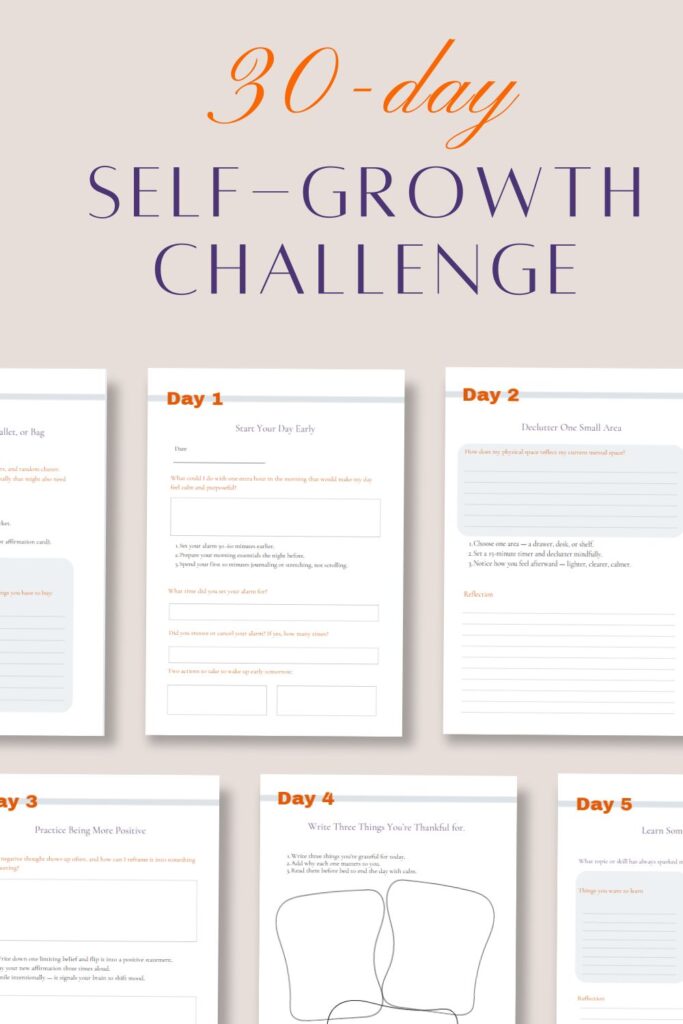
If you’d like to save time, I’ve created a Printable 30-Day Self-Growth Challenge Workbook that walks you through each day with guided prompts, reflection pages, and habit trackers.
It helps you stay organized, motivated, and consistent — without needing to design your own system.
Create an Effective Self-Growth Plan
Success doesn’t come from winging it. It comes from clarity, structure, and consistency.
Before starting your challenge, spend 10–15 minutes creating a mini self-improvement plan.
Use a notebook, a printable self-growth planner, or a daily habit tracker and include:
- Top three self-improvement goals (e.g., wake up early, reduce screen time, start journaling)
- Three new habits to build (e.g., read daily, practice gratitude, move your body)
- Your “why” — the personal reason this challenge matters to you
Keep it simple.
When I first tried a 30-day challenge, I tracked too many things. Narrowing it down to one goal daily made it easier to stay consistent.
You can also personalize your challenge with self-development examples such as:
- Books: Choose a “best book for self-growth” each month (e.g., Atomic Habits, Mindset, The Power of Now).
- Podcasts: Listen to self-growth podcasts for insights, guests, and real stories.
- Quotes: Use self-growth quotes as daily reminders—printable or on wallpapers.
Set aside time each week to reflect on what’s working and where you can adjust.
You Can Choose Your Challenge Mode
One thing I like to incorporate (from experience) is flexibility.
- Standard Mode: You can miss 1–2 days per week, but make up for them later.
- Hard Mode: If you miss one day, you restart. This mode works best for high-priority habits or when you want full accountability.
Pick your mode in advance and treat it as part of the commitment.
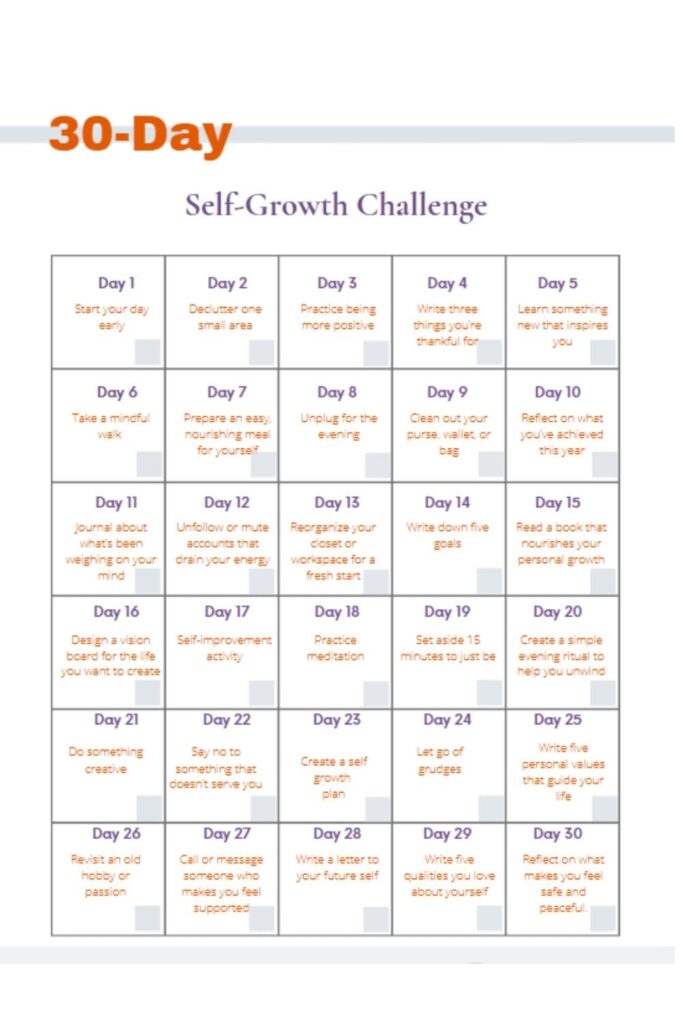
30-Day Self-Growth Challenge Framework
Here’s a suggested layout you could use (or adapt) if you run a 30-day challenge yourself.
| Day | Habit / Focus | Extra Notes / Variation |
|---|---|---|
| 1 | Start your day early | Wake up 30–60 min before usual and use time intentionally |
| 2 | Declutter one small area | A drawer, your desk, a folder |
| 3 | Practice positivity | Write or affirm a positive thought |
| 4 | Write three things you’re thankful for | Gratitude journaling |
| 5 | Learn something new | Short article, video, podcast |
| 6 | Journal about what’s on your mind | Free writing |
| 7 | Reorganize workspace or space | Clean, rearrange |
| 8 | Write five goals | Long-term + short-term |
| 9 | Read a self-growth book | Even 10 pages counts |
| 10 | Unfollow or mute energy-draining accounts | Digital detox step |
| 11 | Take a mindful walk | No phone, just sensory awareness |
| 12 | Cook a nourishing meal | Creative yet healthy |
| 13 | Unplug for evening | No screens 1 hour before bed |
| 14 | Reflect on your achievements | Small and big wins |
| 15 | Clean your purse or wallet | Simplify what you carry |
| 16 | Write a letter to future you | Encouragement, vision |
| 17 | Revisit old hobby | Rediscover joy |
| 18 | Reach out to supporter | Call or message someone |
| 19 | Make a self-improvement plan | Next steps beyond this 30 days |
| 20 | List qualities you admire in yourself | Self-esteem boost |
| 21 | Gratitude check (three more) | Deepen awareness |
| 22 | Design a vision board | Visual inspiration |
| 23 | Do a self-improvement activity | Online course, workshop |
| 24 | Meditate or breathwork | Even 5–10 min |
| 25 | Just be (no doing) | Pause, rest, observe |
| 26 | Stretch the challenge | Slightly more effort or expand habit |
| 27 | Get creative | Art, writing, music |
| 28 | Release grudges | Forgiveness, letting go |
| 29 | Define core values | What truly matters |
| 30 | Say no to something draining | Set a boundary |
If you’re using the Printable 30-Day Self-Growth Challenge Workbook, now’s a great time to check your progress.
This helps you stay consistent even on busy days.
Using Journaling Prompts for Self-Growth
Journaling is powerful. It helps you track your progress, understand emotions, and clarify what matters most.
Try these journaling prompts:
- What are three things that make me feel fulfilled?
- What limiting belief should I release this month?
- What would my ideal day look like?
- How can I show up for myself on tough days?
A self-growth worksheet can help you track reflections. Over time, you’ll notice patterns in what energizes you and what holds you back.
Self-Improvement Goals and Habits That Stick
Focus on habits that are realistic, measurable, and meaningful.
Examples:
- Read 10 pages of a personal development book daily
- Meditate every morning for 5 minutes
- Journal every evening
- Replace one negative thought with a positive statement.
- Go to bed and wake up at consistent times
It’s not about doing everything. It’s about staying consistent with what matters.
Tips if you struggle with procrastination:
- Analyze factors that make you procrastinate
- Eliminate excuses that are not valid for your purpose
- Prioritize tasks and set rules
- Use a reward to stay motivated
A challenge is only as good as your ability to stick with it.
Around week two, motivation may dip. That’s normal.
What helped me:
- Review my “why” each day.
- Check my self-growth planner to see progress
- Reward myself weekly.
- Replaced “I have to” with “I get to.”
- Surround myself with positive influences.
If you slip, don’t give up. Start again the next day. Every day is a fresh opportunity.
Use the “Don’t Break the Chain” mindset
If you miss a day in your 30-day challenge, you have a few options:
- In Standard Mode, you allow yourself 1–2 missed days per week but make them up later so you still finish 30
- In Hard Mode, you restart the challenge if you miss a single day
Choose the mode ahead of time to avoid decision fatigue.
Anchor new habits to existing routines
Tie your new habit to something you already do. For example:
- After brushing teeth, journal
- After lunch, walk 10 minutes
- Before bed, read 5 pages
This reduces friction and helps your brain connect the dots.
If a habit feels impossible by day 10 or 15, don’t beat yourself up. Adjust your approach, reduce your goal, or change your habit. The important thing is progress, not perfection.
The Demartini Value Determination Process (optional enrichment)
The Demartini Value Determination Process is the best method that I found to assess what truly motivates and values you and align your habits accordingly.
When you know your highest values, your self-improvement plan becomes natural instead of forced. Also can help you uncover hidden drives behind your goals, making your habits more personally meaningful and sustainable.
The 30-Day Self-Growth Challenge is not magic, but it is a powerful framework that can help you transform slowly but surely.
Now is your moment to act.
Don’t wait until the perfect time comes.
Start Your 30-Day Personal Growth Challenge today.
Download it now and see how small daily steps can transform your life.
Recommended reading on self-improvement: